AI-Driven Operations: From Alerts to Action
How AI and machine learning are transforming operational intelligence and enabling smarter incident response.
How AI and machine learning are transforming operational intelligence and enabling smarter incident response.
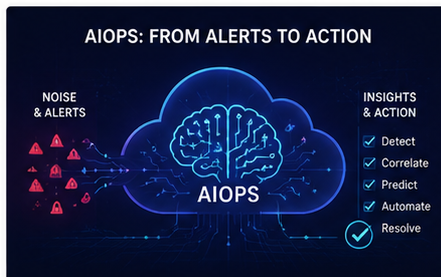
Ask any on-call engineer about their biggest operational challenge, and alert fatigue is likely near the top of the list. Modern systems generate thousands of metrics and log events per minute. Traditional monitoring stacks respond by creating thousands of rules, resulting in thousands of alerts—most of which are noise.
Alert fatigue leads to a predictable cycle: operators stop responding to alerts, which means real problems are missed. The cost is measured in mean time to detection and recovery, in customer impact, and in team burnout.
AI and machine learning are fundamentally changing how we handle this problem. Rather than creating more rules to detect more problems, AIOps systems use algorithms to understand patterns, predict failures, and correlate data in ways humans cannot.
AIOps isn't just adding machine learning to existing monitoring stacks. It's a fundamentally different approach:
Traditional monitoring alerts when a single metric exceeds a threshold. AIOps looks at patterns across hundreds of signals simultaneously. When CPU usage rises alongside network latency and error rates, the system recognizes this as a correlated event rather than three independent problems.
Instead of reacting after something breaks, ML models can forecast problems before they impact users. For example, by analyzing storage growth patterns, predictions can trigger capacity scaling days before a disk runs full. By analyzing error rate trends, systems can predict outages hours in advance.
AIOps systems learn what normal looks like. Temporary blips that self-correct are not escalated. Anomalies that actually matter are surfaced clearly. The result: alert volume drops while accuracy increases.
Beyond alerting, modern AIOps systems can automatically execute remediation actions. Detect a cascading failure? Trigger automatic failover. Detect runaway resource consumption? Trigger autoscaling. Detect a bad deployment? Trigger rollback. These actions happen in milliseconds, often before any human is even alerted.
ML models trained on baseline behavior can instantly spot deviations. Unlike threshold-based alerting, anomaly detection adapts to seasonal patterns, growth trends, and normal variation. A metric that rises 30% might be normal if it's always followed a deployment pattern, but abnormal if it's isolated.
When incidents occur, AIOps correlates data across logs, metrics, and traces to identify root causes automatically. Instead of engineers manually reviewing hundreds of dashboards and logs, the system narrows the search space to the most likely culprits. This dramatically reduces mean time to resolution.
A single underlying problem often triggers multiple alerts. AIOps uses ML to recognize that twenty different alerts are actually manifestations of the same problem, creating a single incident and reducing cognitive load on responders.
AIOps can route incidents to the most appropriate team based on historical patterns. If database performance problems are consistently resolved by the data engineering team, future similar incidents route there automatically. Escalation becomes intelligent: if the primary team doesn't acknowledge within a learned time window, escalate based on incident severity and business context.
AIOps systems can extract learnings automatically. If a particular error message consistently precedes customer impact, the system learns to elevate the severity of that error and alert earlier. If specific log patterns appear before failures, those patterns become predictive signals.
AIOps can't work without quality data. Ensure your observability stack is comprehensive: metrics, logs, traces, and events. Invest in instrumentation. Standardize on logging and metric formats. This is table stakes.
Don't try to implement autonomous remediation on day one. Start with anomaly detection across your most important services. Let the system learn normal behavior for a baseline period (typically 2-4 weeks). Then introduce it to your on-call rotations, initially in alert-only mode.
Connect your AIOps platform to your incident management system. Start with intelligent alert grouping and deduplication. Track how many duplicate alerts this eliminates. This metric alone justifies AIOps investment.
Integrate business context into incident analysis. Connect to change management systems, deployment logs, feature flags, and traffic analysis. When the system sees an anomaly coinciding with a recent deployment, it provides that context automatically.
As the system proves reliable, enable automatic remediation for low-risk actions. Start with actions that can be easily rolled back: restart a service, scale a resource, clear a cache. Build confidence before automating more consequential actions.
Pitfall: Garbage in, garbage out. If your baseline data includes incidents, your ML models will learn from bad data. Before training, clean your data by removing incident periods.
Pitfall: Over-tuning. It's tempting to tweak thresholds constantly. Resist this. Let the system learn from real-world data. Excessive tuning creates brittle systems.
Pitfall: Trusting the system too quickly. ML models make mistakes. Humans should remain in the loop, especially for automatic remediation. Audit decisions, track accuracy, and keep human override always available.
Pitfall: Ignoring feedback loops. When humans disagree with the system's alert or decision, feed that feedback back into the model. Over time, this makes the system increasingly accurate.
Beyond technical benefits, AIOps has profound organizational effects. It reduces alert fatigue and on-call burnout. It speeds incident detection and resolution. It enables smaller teams to manage larger, more complex systems. It shifts work from reactive firefighting to proactive improvement.
Perhaps most importantly, it frees engineering leaders to focus on strategy, growth, and long-term reliability improvements rather than getting pulled into every operational incident.
AI and machine learning are not hypothetical future technologies for operations—they're available today and delivering measurable value. Organizations that adopt AIOps thoughtfully, starting with data quality and gradually expanding capabilities, gain operational advantages that compound over time: faster detection, faster resolution, less alert noise, and more time for strategic work.
The future of operations is not better humans at monitoring—it's smarter systems augmenting human decision-making.
The SRE Leadership Hub provides practical insights, frameworks, and advisory guidance for building reliable, scalable, and intelligent engineering organizations.
Explore how forward-thinking organizations are shifting reliability from an operational concern to a core business strategy.
Beyond traditional metrics: how to measure and improve the true resilience of your engineering organization.
Subscribe to our newsletter for engineering leadership perspectives and insights.