Building Effective SLOs and Error Budgets
Learn how to define meaningful SLOs and use error budgets as a powerful tool for balancing reliability and velocity.
Learn how to define meaningful SLOs and use error budgets as a powerful tool for balancing reliability and velocity.
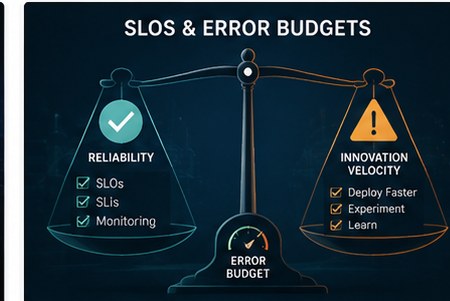
Every engineering leader faces a fundamental tension: product teams want to move fast and ship features, while reliability teams want to maintain stability and minimize incidents. Traditional approaches often pit these goals against each other, creating organizational friction and poor outcomes.
Service Level Objectives (SLOs) and error budgets provide a data-driven framework for resolving this conflict. Rather than debating reliability in abstract terms, SLOs and error budgets quantify what "good enough" means and create alignment across the organization.
An SLO is a concrete commitment about how reliable your service should be. Unlike a generic statement like "we want high availability," an SLO provides specific, measurable targets.
These related terms are often confused:
A Service Level Indicator (SLI) is the actual measurement of your service's performance. For example, "98.7% of requests returned a response in under 200ms last week."
A Service Level Objective (SLO) is your target. For example, "we aim to keep 99% of requests under 200ms (monthly measurement)."
A Service Level Agreement (SLA) is a contract. It's what you commit to externally, often with financial penalties for breaches. An SLA is typically stricter than your internal SLO to provide a buffer.
Different services require different metrics. A payment processing system needs different SLOs than a content recommendation engine. Consider:
Percentage of successful requests. Common targets: 99%, 99.5%, 99.9%, 99.95%, 99.99%. Each additional nine represents roughly 8.76 additional hours of allowed downtime per year.
How fast requests are served. For example: "95% of requests complete within 200ms, 99% within 500ms." Tail latency (p99, p99.9) matters more than average latency for user experience.
For data systems: what percentage of data survives intact over time? Common for storage services and databases.
Results are accurate and consistent. Critical for financial systems, analytics, and ML pipelines.
An error budget is the flip side of your SLO. If your SLO is 99.9% availability, your error budget is 0.1% downtime. That translates to roughly 43 minutes of acceptable downtime per month.
Here's the powerful part: if you're tracking to your SLO, you have permission to use your error budget. While it sounds counterintuitive, this creates alignment:
The most common SLO mistakes come from setting targets without understanding business context. Here's how to do it right:
What do users actually care about? For a real-time communication platform, latency might matter more than total availability. For a batch data processing service, daily availability might be fine.
Don't measure from your monitoring's perspective. If your monitoring system is down but users are happy, that's not an SLO breach. Use synthetic monitoring that mimics real user workflows.
Don't set 99.99% availability if you've historically achieved 99%. Set your SLO at or slightly above your current performance, then improve over time. An SLO you can't meet becomes useless.
Each SLO has operational cost. Monitoring, alerting, incident response, and compliance all grow with complexity. Start with 2-3 metrics per service, not twenty.
Involve product, finance, and customer success in SLO decisions. Your SLO should reflect business priorities, not just technical possibilities.
Once you have SLOs, establish clear policies for how you'll respond to different error budget states:
Healthy (>30% budget remaining): Deploy freely within normal processes. Take on technical debt if it enables velocity.
Cautious (10-30% budget remaining): Deploy only high-priority changes. Pause risky experiments. Increase testing rigor.
Critical (<10% budget remaining): Deploy only critical bug fixes. Pause all feature work. Focus on reliability improvements. May declare a "reliability week."
Overdrawn: If you exceed your error budget, conduct a blameless postmortem. Understand what happened and prevent recurrence.
Moving from theory to practice requires careful execution. Start with a pilot service. Instrument monitoring. Calculate your current performance. Set realistic targets. Monitor them. Adjust policies as you learn.
Communicate SLOs widely. Make error budget dashboards visible to product teams. Make it easy for engineers to check current budget before deploying. Celebrate when you hit targets; learn from misses.
Remember that SLOs are tools for organizational alignment, not punitive measures. The goal is to empower teams to make faster, better-informed decisions about reliability and velocity trade-offs.
SLOs and error budgets transform reliability from a nebulous concept into a measurable, business-aligned objective. They provide the framework for product teams and reliability teams to work together, not in conflict. When done well, they accelerate innovation while protecting the reliability that customers depend on.
The best error budget is one that's actively used by product teams to make informed decisions about when to go fast and when to go careful.
The SRE Leadership Hub provides practical insights, frameworks, and advisory guidance for building reliable, scalable, and intelligent engineering organizations.
Explore how forward-thinking organizations are shifting reliability from an operational concern to a core business strategy.
Beyond traditional metrics: how to measure and improve the true resilience of your engineering organization.
Subscribe to our newsletter for engineering leadership perspectives and insights.