Cloud Strategy: From Planning to Execution
A practical framework for developing and executing successful cloud transformation initiatives.
A practical framework for developing and executing successful cloud transformation initiatives.
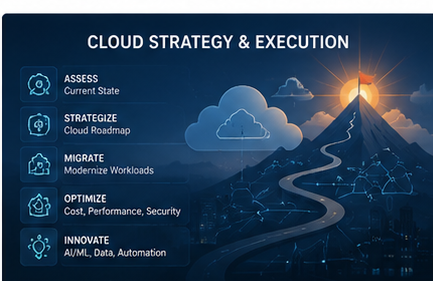
Cloud adoption is no longer optional. Market leaders operate in cloud environments. Startups are born on cloud. Legacy organizations are modernizing on cloud. The question for engineering leaders is not whether to move to cloud, but how to do so strategically and effectively.
Yet many organizations treat cloud migration as a pure infrastructure project. They move workloads from data centers to cloud providers and declare victory. Invariably, costs spiral out of control, performance disappoints, or security gaps emerge. Without a strategic approach, cloud fails to deliver on its promise.
AWS articulates six common migration strategies. Understanding each helps organizations make informed decisions:
Move existing applications to cloud with minimal changes. This is fastest but doesn't capture most cloud benefits. Ideal for temporary workloads or applications that are difficult to modify. Warning: cloud costs can exceed on-premises costs if applications aren't optimized.
Move workloads with some optimization. Update database engines, modernize middleware, optimize for cloud-native features. Balance speed with cost and performance improvements.
Redesign applications for cloud architecture. Use microservices, serverless, managed services. Takes longest but delivers maximum cloud benefits: scalability, cost efficiency, and operational advantages. Recommended for business-critical applications.
Replace custom applications with commercial SaaS products. Examples: migrate from on-premises email to Microsoft 365, or replace custom CRM with Salesforce. Simplifies operations at the cost of customization flexibility.
Stop using applications that don't provide value. This is often overlooked but one of the highest-ROI moves. Organizations typically find 10-20% of applications can be retired entirely.
Sometimes the best decision is to stay on-premises. This applies to systems deeply integrated with physical infrastructure, applications with strict compliance requirements, or legacy systems where migration cost exceeds benefit.
Why are you moving to cloud? Cost reduction? Scalability for growth? Access to new capabilities? Time to market acceleration? Specific drivers shape strategy. A cost-focused migration looks different from an innovation-focused migration.
Catalog all applications and infrastructure. For each application, understand: current annual costs, criticality to business, interdependencies, compliance requirements, and technical debt. This inventory is your foundation.
Don't migrate everything simultaneously. Create waves: quick wins (candidate applications that are simple to migrate), core workloads (critical but more complex), and remaining workloads. Quick wins build momentum and organizational learning.
Cloud migration is ultimately people change. Engineers need training in cloud platforms. Operators need to learn new monitoring and debugging approaches. Architects need to understand cloud design patterns. Invest heavily in training and hiring cloud expertise.
Cloud's self-service nature is powerful but requires guardrails. Define policies for: network architecture, security baselines, cost controls, data residency, and backup requirements. Governance prevents costly mistakes and security gaps.
Cloud costs are easy to spiral. Implement: budgets and alerts, reserved instances for predictable workloads, rightsizing of instances, automated shutdowns for non-production environments. Cost management requires continuous attention.
Pilot cloud with a non-critical application. Learn cloud design patterns, security approaches, and operational procedures. Build organizational experience before migrating mission-critical systems.
Migration is never truly lift-and-shift. Plan for parallel operation, gradual cutover, and rollback capabilities. The cost of downtime typically vastly exceeds the cost of migration overlaps.
Data movement is often the constraint. Data sizes, transfer times, compliance requirements, and residency regulations all matter. Plan data strategies early.
Cloud's value includes managed services. Rather than running your own databases or message queues, use cloud-provided services. This reduces operational burden and allows teams to focus on differentiating work.
New development should target cloud architecture immediately. Using cloud-native patterns from the start prevents future rework and ensures teams are building for cloud capabilities.
Pitfall: Treating cloud as infrastructure only. Cloud enables organizational transformation: faster deployments, self-service infrastructure, better visibility. Capturing these benefits requires changes beyond infrastructure.
Pitfall: Uncontrolled costs. Without governance, cloud spending spirals quickly. Implement cost management from day one, not as an afterthought.
Pitfall: Neglecting security. Cloud security is different from data center security. Understanding shared responsibility models and cloud-specific security practices is essential.
Pitfall: Big bang migrations. Attempting to migrate everything simultaneously creates risk, coordination problems, and operational stress. Waves are safer.
Cloud transformation is a multi-year journey that combines technology change, organizational change, and cultural change. Organizations that approach cloud strategically—with clear business drivers, thoughtful migration planning, proper governance, and investment in people—capture tremendous value. Organizations that view cloud as a simple infrastructure upgrade often disappoint. The difference lies in strategic thinking and disciplined execution.
Cloud is not about infrastructure. It's about speed, flexibility, and organizational capability. The infrastructure is just the enabler.
The SRE Leadership Hub provides practical insights, frameworks, and advisory guidance for building reliable, scalable, and intelligent engineering organizations.
How internal developer platforms (IDPs) scale engineering effectiveness and accelerate product delivery.
Practical strategies for implementing DevOps practices and building a culture of continuous improvement.
Subscribe to our newsletter for engineering leadership perspectives and insights.