Platform Engineering as a Force Multiplier
How internal developer platforms (IDPs) scale engineering effectiveness and accelerate product delivery.
How internal developer platforms (IDPs) scale engineering effectiveness and accelerate product delivery.
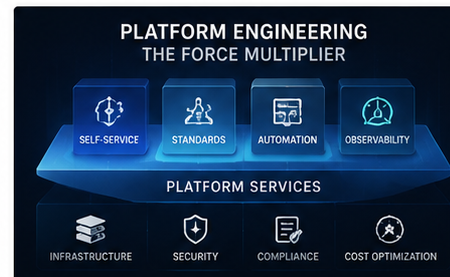
As organizations scale, a paradox emerges: while the organization grows, individual developer velocity decreases. New engineers spend weeks onboarding. Deployments require orchestrating across dozens of tools and complex manual steps. Infrastructure changes take weeks to implement. What once felt like a nimble startup becomes bureaucratic and slow.
The root cause is often invisible: cognitive overhead and friction in the development experience. Platform engineering addresses this by building internal developer platforms (IDPs) that make common tasks easy while maintaining governance, security, and reliability.
Platform engineering is the discipline of building and maintaining systems, tools, and processes that enable product development teams to operate more effectively. It treats developer experience as a product, with dedicated teams focused on reducing friction.
An IDP is not a monolithic system but rather a thoughtfully integrated ecosystem of tools, abstractions, and services. It typically includes infrastructure provisioning, deployment pipelines, observability, secrets management, networking, and documentation—all integrated into a cohesive experience.
Modern systems are complex. Multiple cloud regions, containerization, microservices, message queues, databases, caching layers, CDNs, and more. No individual developer can be an expert in all components. Platforms abstract away complexity while maintaining necessary control.
Without a platform, growth creates coordination problems. Twenty engineers can work somewhat independently. Two hundred engineers cannot. Platforms provide shared patterns and services that allow teams to work independently while remaining coordinated.
In competitive markets, speed of delivery matters immensely. Platforms enable faster feature development by eliminating repeated setup work. Instead of each team solving infrastructure problems independently, the platform team solves them once for everyone.
A self-service interface for provisioning databases, caches, queues, and other infrastructure. Developers request what they need; the platform handles provisioning, configuration, and ongoing management. This replaces manual ticket processes with instant gratification while maintaining governance.
A standard deployment process that's secure and reliable. Developers push code; the platform builds, tests, and deploys. Different services can have different requirements, but the overall experience is consistent.
Automatic instrumentation and log collection. When a service is deployed, observability is automatically wired up. Developers don't need to think about logging infrastructure; it's included in the platform.
Secrets management, access control, audit logging, and compliance enforcement. Security policies are embedded into the platform rather than enforced through external reviews and approval processes.
Service discovery, load balancing, and inter-service communication. Developers don't manually configure how services find and talk to each other; the platform handles it.
Integrated alerting, incident tracking, and on-call scheduling. When the platform detects issues, it automatically engages the right people. Blameless postmortems are tracked and learnings are recorded.
Don't build a comprehensive platform in isolation. Start by identifying the top 3-5 frictions developers experience daily. Usually these are: deploying services, provisioning databases, accessing logs, debugging in production, and managing secrets.
Every organization is different. A platform that works for a fintech company might be wrong for an early-stage startup. Build based on your specific constraints: team size, technology choices, regulatory requirements, and growth trajectory.
Don't require immediate migration to the platform. Start with opt-in adoption. Pilot with willing teams. Let the platform prove value. This reduces resistance and allows refinement based on real feedback.
A powerful platform with terrible user experience will be abandoned. Invest in clear documentation, intuitive interfaces, helpful error messages, and responsive support. The platform team should view developers as their customers.
The platform should handle common patterns and shared infrastructure. It should not dictate every architectural decision or constrain innovation. Provide sensible defaults; allow override when justified.
Organizations that implement platforms well see measurable improvements. Deployment frequency increases 2-3x. Time from code commit to production shrinks from hours to minutes. Mean time to recovery improves because developers have better observability and faster rollback. Most importantly, teams can focus on product delivery rather than infrastructure.
This translates to competitive advantage: faster feature delivery, better reliability, and improved developer satisfaction and retention.
Pitfall: Over-engineering. Building a comprehensive platform before understanding actual needs. Start small, iterate based on feedback.
Pitfall: Forcing adoption. Mandating platform use before it's proven valuable creates resistance and resentment. Let success drive adoption.
Pitfall: Ignoring feedback. The platform team builds features that seem important but developers don't use. Close the feedback loop. Make developer satisfaction a success metric.
Pitfall: Never maintaining. Platforms require ongoing maintenance and evolution. Platforms that stagnate become unusable as technology changes.
Platform engineering is how organizations scale without sacrificing speed or developer happiness. By investing in tools and processes that reduce friction, engineering leaders enable their teams to accomplish more with the same headcount. In competitive markets, that's a substantial advantage.
The best platform disappears into the background—developers hardly notice it, but can't imagine working without it.
The SRE Leadership Hub provides practical insights, frameworks, and advisory guidance for building reliable, scalable, and intelligent engineering organizations.
Practical strategies for implementing DevOps practices and building a culture of continuous improvement.
Creating engineering leaders and leadership cultures that support organizational growth and reliability.
Subscribe to our newsletter for engineering leadership perspectives and insights.