Building Engineering Leadership That Scales
Creating engineering leaders and leadership cultures that support organizational growth and reliability.
Creating engineering leaders and leadership cultures that support organizational growth and reliability.
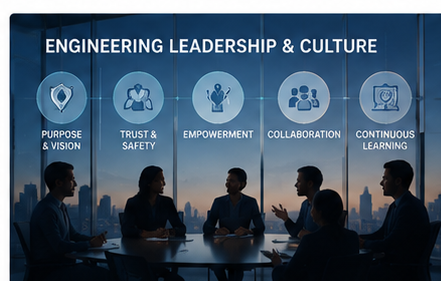
Growing organizations face a common problem: their best engineers are promoted into management without preparation or support. These newly minted managers inherit technical credibility but lack leadership skills. Result: frustrated managers, burned-out teams, and lost talent.
Meanwhile, organizations desperately need more leaders. A single senior engineering leader can influence dozens of engineers through mentorship, planning, and decision-making. Building a pipeline of strong leaders is one of the highest-leverage activities an engineering organization can pursue.
Engineering leaders must understand technology deeply enough to make sound decisions and earn respect. They don't need to be the smartest engineer on the team, but they need sufficient technical depth to evaluate tradeoffs and mentor others.
Technical skills are necessary but insufficient. Effective leaders can recruit talent, develop team members, provide clear feedback, make difficult personnel decisions, and create psychological safety where people can do their best work.
Leaders translate between technical details and business strategy. They communicate upward to executives, laterally to peer teams, and downward to their teams. They do this clearly, concisely, and with appropriate context for each audience.
Leaders make decisions with incomplete information under time pressure. They gather input from their teams, consider tradeoffs, and commit to decisions. They create clarity and alignment where ambiguity existed.
Engineers trust leaders who are predictable and have good judgment. Leaders who frequently reverse decisions, play politics, or prioritize personal advancement over team success quickly lose credibility and effectiveness.
Strong potential leaders typically show certain patterns: they take ownership of problems larger than their immediate responsibilities, they mentor less experienced engineers, they think about system-level impacts, they drive cross-team initiatives. Identify these patterns early. These are your future leaders.
Leadership is learned through practice. Create opportunities for high-potential engineers to lead:
Don't assume smart engineers automatically become good leaders. They need training in management fundamentals, communication, conflict resolution, and decision-making. Provide training, coaching, and development resources.
Pair emerging leaders with senior leaders for mentorship. This isn't passive advice-giving; it's active coaching on real-world situations. Mentors should model good leadership and create space for mentees to wrestle with difficult decisions.
As engineers transition to leadership roles, make expectations clear. Leadership involves tradeoffs: they'll write less code; they'll have more meetings; they'll deal with personnel issues. Not every engineer wants leadership responsibilities. Provide growth paths for individual contributors too.
Each team has a single engineering manager with direct responsibility for hiring, performance, and development. Works well for teams up to 6-8 engineers. Beyond that, additional hierarchy is needed.
Separate technical leadership (tech lead) from people leadership (manager). Tech leads drive technical vision; managers handle people and process. Both roles are necessary and require different skills. This structure works well in larger, complex engineering organizations.
Rather than single authoritarian leader, distribute leadership across the team. Different people lead on different topics: one person owns technical strategy, another owns hiring, another owns process. Creates distributed ownership and leverages diverse strengths.
Strong engineering organizations have cultures where people can take interpersonal risks: admitting mistakes, asking for help, dissenting with ideas, and proposing unpopular positions without fear of humiliation or retaliation. Leaders create this culture through how they respond when these risks are taken.
Engineers do their best work when expectations are clear. Leaders articulate what success looks like, what tradeoffs matter, and what decisions are negotiable versus fixed. Clarity reduces anxiety and enables focus.
Good leaders provide regular, specific feedback. Annual reviews are insufficient. Create continuous feedback mechanisms. Help people understand how they're doing and how they can improve.
Engineers are motivated by challenging, meaningful work. Leaders create conditions where people work on problems that matter, where they're stretched appropriately, and where they see the impact of their work.
Mistake: Promoting based on technical skill alone. Exceptional engineers don't always make good leaders. Consider people skills, communication ability, and genuine interest in developing others before promoting.
Mistake: Inadequate preparation for promotion. Surprise promotions without transition support set leaders up for failure. Transition gradually, with mentorship and training.
Mistake: Treating leadership as higher status. Engineering and leadership are different career paths, not hierarchical ranks. Senior individual contributors should be respected equally with senior leaders.
Mistake: Tolerating bad leaders. A bad leader contaminates an entire team. Address leadership problems directly and quickly.
Organizations that invest in building strong engineering leadership outpace competitors. They scale faster, retain talent better, make better technical decisions, and build stronger cultures. The investment in identifying, developing, and supporting engineering leaders pays enormous dividends.
The mark of a successful leader is not what they accomplish personally, but what their team accomplishes under their guidance.
The SRE Leadership Hub provides practical insights, frameworks, and advisory guidance for building reliable, scalable, and intelligent engineering organizations.
How internal developer platforms (IDPs) scale engineering effectiveness and accelerate product delivery.
Practical strategies for implementing DevOps practices and building a culture of continuous improvement.
Subscribe to our newsletter for engineering leadership perspectives and insights.