The DevOps Transformation Journey
Practical strategies for implementing DevOps practices and building a culture of continuous improvement.
Practical strategies for implementing DevOps practices and building a culture of continuous improvement.
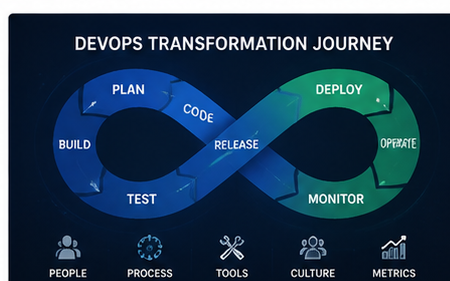
In traditional organizations, development and operations are separate functions with conflicting incentives. Developers want to move fast and deploy frequently. Operations wants stability and predictability. This conflict creates organizational tension, slow deployments, and finger-pointing when things break.
DevOps is the antidote. It's not a job title; it's a cultural and organizational movement toward shared ownership of the entire software delivery lifecycle. Organizations that embrace DevOps see dramatic improvements: faster deployments, fewer outages, lower costs, and happier teams.
Rather than developers throwing code over the wall to operations, DevOps means the entire team shares responsibility for delivering, running, and supporting software. Developers understand operational concerns; operations understands development challenges.
DevOps organizations treat improvement as continuous work, not a separate project. Every deployment, every incident, every failure is an opportunity to learn and improve processes. This mindset compounds over time.
Manual processes don't scale and are error-prone. DevOps prioritizes automation: infrastructure as code, automated testing, automated deployments, automated monitoring. Measurements drive decisions.
Incidents happen in complex systems. Rather than blaming individuals, DevOps organizations focus on understanding failures, fixing systems, and learning. This enables people to take reasonable risks and report problems early.
Treat infrastructure like code: version controlled, reviewed, tested, and deployed automatically. This eliminates snowflake servers and enables reproducible environments. Infrastructure becomes auditable and recoverable.
Developers commit code frequently (daily or multiple times per day) to a shared mainline. Each commit triggers automated tests. Broken code is caught and fixed immediately, not days later. This reduces integration pain.
Extend CI to CD: after testing passes, code is automatically deployed to production. This removes manual deployment steps and enables faster feedback. Teams can deploy hundreds of times per day if needed.
Production visibility is critical. Modern systems generate enormous data: logs, metrics, traces, and events. Organize this data so teams can understand system behavior, diagnose problems, and predict failures.
Manual testing doesn't scale. Implement automated testing at multiple levels: unit tests verify code logic, integration tests verify component interactions, end-to-end tests verify complete user workflows. Fast automated feedback replaces slow manual testing.
Incidents are inevitable. Handle them well: clear incident command structures, rapid communication, effective mitigation, and thorough postmortems. Learn from every incident to prevent recurrence.
Audit your current practices. How long does deployment take? How often does it fail? How many manual steps are involved? How is observability organized? How are incidents handled? Establish baseline metrics. This is your starting point.
Don't transform everything simultaneously. Identify the biggest bottleneck or pain point. Usually this is either deployment frequency or incident response. Focus there first.
Invest in tools and infrastructure: source control, CI/CD pipeline, monitoring, logging, deployment automation. These are table stakes for DevOps practices. If deployment requires weeks of manual work, you can't move fast.
Tools alone don't create culture. Establish practices: code review standards, testing requirements, deployment procedures, incident management processes. Make expectations clear.
The hardest part is cultural change. Developers must care about operations; operations must understand development. Reward shared ownership. Celebrate deployments, not just averted disasters. Make it safe to fail and learn.
Track four key metrics: deployment frequency, lead time for changes, mean time to recovery, and change failure rate. Use these to guide improvements. As things improve, tackle the next constraint.
Organize teams around services or features, not by function. Each team includes developers and operators (or developers trained in operational concerns). This creates ownership and reduces handoffs.
Provide shared infrastructure and tools. A platform team owns CI/CD, monitoring, logging, and deployment infrastructure. This centralizes specialized knowledge while enabling product teams to move fast.
While platform teams provide infrastructure, product teams own their services end-to-end. They deploy their code, handle their incidents, and manage their operational concerns. This creates accountability.
Challenge: Resistance from ops teams. Operations may fear DevOps means their jobs disappear. In reality, DevOps evolves ops roles toward higher-value work: infrastructure architecture, platform building, reliability engineering. Frame this positively.
Challenge: Siloed teams resist cross-functional organization. Breaking functional silos is difficult. Start with pilots. Build relationships between developers and operators. Celebrate joint wins. Create shared incentives.
Challenge: Technical debt blocks transformation. Legacy systems with poor observability or manual deployments are hard to automate. Address technical debt as part of transformation, not after. Invest in refactoring and improvements.
Challenge: Measuring progress is unclear. Use the four key metrics above. Track them religiously. Share progress widely. Celebrate improvements. Metric visibility drives behavior change.
Smaller teams can move faster. Focus on automation and shared ownership from day one. Don't wait for formal processes; build them as you grow.
At 50-200 engineers, organization becomes important. Create platform teams. Establish practices. Build communities of practice (SRE guild, DevOps guild) to share knowledge across silos.
Large organizations have the resources to invest in platforms and tooling. The challenge is coordination across teams. Use federation: empower teams within guardrails. Create shared standards. Invest in internal platforms.
DevOps transformation is not a sprint; it's a journey. Success requires changes in tools, processes, and culture. Organizations that commit to the transformation see remarkable improvements in delivery speed, reliability, and team satisfaction. The investment pays dividends across the business.
DevOps isn't about tools. It's about people working together with shared goals, supported by appropriate automation and practices.
The SRE Leadership Hub provides practical insights, frameworks, and advisory guidance for building reliable, scalable, and intelligent engineering organizations.
How internal developer platforms (IDPs) scale engineering effectiveness and accelerate product delivery.
Creating engineering leaders and leadership cultures that support organizational growth and reliability.
Subscribe to our newsletter for engineering leadership perspectives and insights.